Key takeaways
- Sunscreen is the only step in a daily routine with randomized-trial evidence: 24% less skin aging over 4.5 years, and half the melanomas.
- Most people apply 20–50% of the amount needed to reach the SPF on the label, so an SPF 30 often performs like an SPF 10.
- In Louisiana humidity, cream products outlast powder — powder sets hard, then breaks apart.
- Everything past cleanser, moisturizer and SPF is preference, not evidence. I'll say so where that's true.
Hi, it's Cami. I spend my days looking at faces in good salon light, and here's what I've noticed: the people who look best on a regular Tuesday are almost never the ones wearing the most product. They're the ones whose skin is in good shape, wearing three or four things well.
And wearing less isn't giving up on yourself. It's not vanity; it's self-care, and the two get confused constantly.
So let me tell you what I actually keep on my own counter, and — more usefully — which single step has real clinical evidence behind it. Because one of them does, and the rest are preference. I'd rather tell you which is which than sell you a ten-step routine you'll abandon by March.
The one step that's actually proven
Sunscreen is the only part of a daily routine with randomized-trial evidence behind it. In a 4.5-year trial of 903 adults published in Annals of Internal Medicine, the group using sunscreen daily showed 24% less skin aging than the group using it at their own discretion (odds ratio 0.76, 95% CI 0.59–0.98). Not a serum. Not a ten-step routine. Sunscreen.
The same Queensland research group followed participants for melanoma outcomes and published in the Journal of Clinical Oncology: regular sunscreen users developed 11 primary melanomas versus 22 in the discretionary group — a 50% reduction.
I'm not going to pretend the rest of what I do has that kind of backing. It doesn't. But that one does, and it's the cheapest step in the routine.
"Skin aging from baseline to the end of the trial was 24% less in the daily sunscreen group than in the discretionary sunscreen group." — Hughes, Williams, Baker & Green, Annals of Internal Medicine, 2013
You are almost certainly using too little
This is the statistic that changed how I talk about sunscreen. According to the American Academy of Dermatology, most people apply only 20–50% of the amount needed to reach the SPF on the label. Your SPF 30 is behaving like an SPF 10 or 15.
That matters more than the number on the bottle. SPF 30 blocks 97% of UVB rays, and no sunscreen blocks 100% — so chasing SPF 70 while applying a thin smear is solving the wrong problem.
How much you apply changes the number more than the label does. Application-amount data: American Academy of Dermatology, Sunscreen FAQs, 2025. SPF 30 or higher, broad spectrum, water resistant Face amount 1 teaspoon — the length of your index and middle fingers Body amount 1 ounce — a shot glass Timing 15 minutes before you go outside Reapply Every 2 hours, or after swimming or sweating Cloudy days Still required — up to 80% of UV comes through cloud Shelf life FDA requires full strength for at least 3 yearsSource: American Academy of Dermatology, Sunscreen FAQs, 2025.
One in five Americans will develop skin cancer in their lifetime. In south Louisiana, where we get sun in February, I'd rather you wore an SPF 30 properly than an SPF 50 badly.
What I actually put on
Tint over full coverage. A tinted moisturizer or a light BB cream evens tone without sitting on top of the skin. In Hammond humidity, heavy foundation has nowhere to go — it moves, it settles into lines, and by 2pm it looks like it's wearing you.
One eye thing, not four. Mascara, or a soft shadow that matches your eye colour. Not both plus liner plus a brow pencil. If you've had your brows shaped, they already do the work — that's the whole point of brow shaping.
A lip a shade or two deeper than your own. It reads as "you, rested" rather than "you, wearing lipstick."
Cream, not powder. This is the Louisiana-specific one, and it's the tip I give most often. Powder products set hard and then break apart when the humidity climbs. Cream blush and cream bronzer move with your skin instead of flaking off it.
Hammond mornings run near 88% relative humidity — we sit between Baton Rouge and New Orleans, both of which average 88% at 6am against roughly 56–61% by mid-afternoon. That thirty-point swing is why makeup that looked correct at 7am has migrated by lunch. You are not imagining it, and it is not your technique — it's the same swing that drives Louisiana winter hair care.
Early morning ~88% Powder absorbs moisture, goes patchy Mid-afternoon ~56–61% Dries down, then cracks at expression lines Evening, outdoors Climbing again Re-absorbs, slidesHumidity normals for Baton Rouge and New Orleans: World Data Center for Meteorology, via Current Results.
The practical version: set only your T-zone, if you set anything at all. Leave the cheeks cream. They'll still be there at 5pm.
The routine underneath it
Makeup sits on skin, so the skin matters more than the makeup. Cleanser, moisturizer, sunscreen — that's the core. The Cleveland Clinic makes the same point: a simple routine you keep up beats an elaborate one you don't.
Three products isn't a magic number, and I won't pretend there's a study behind it. It's the number that survives a real week. From what I see in the chair, the short routine is the one still running in March; the twelve-step version is usually abandoned by the third week of January. A routine you complete beats a better routine you skip.
That's also why I'd rather you spent money on a sunscreen you genuinely like the feel of than on a serum with a longer ingredient list. You'll use the first one.
What this looks like in the chair
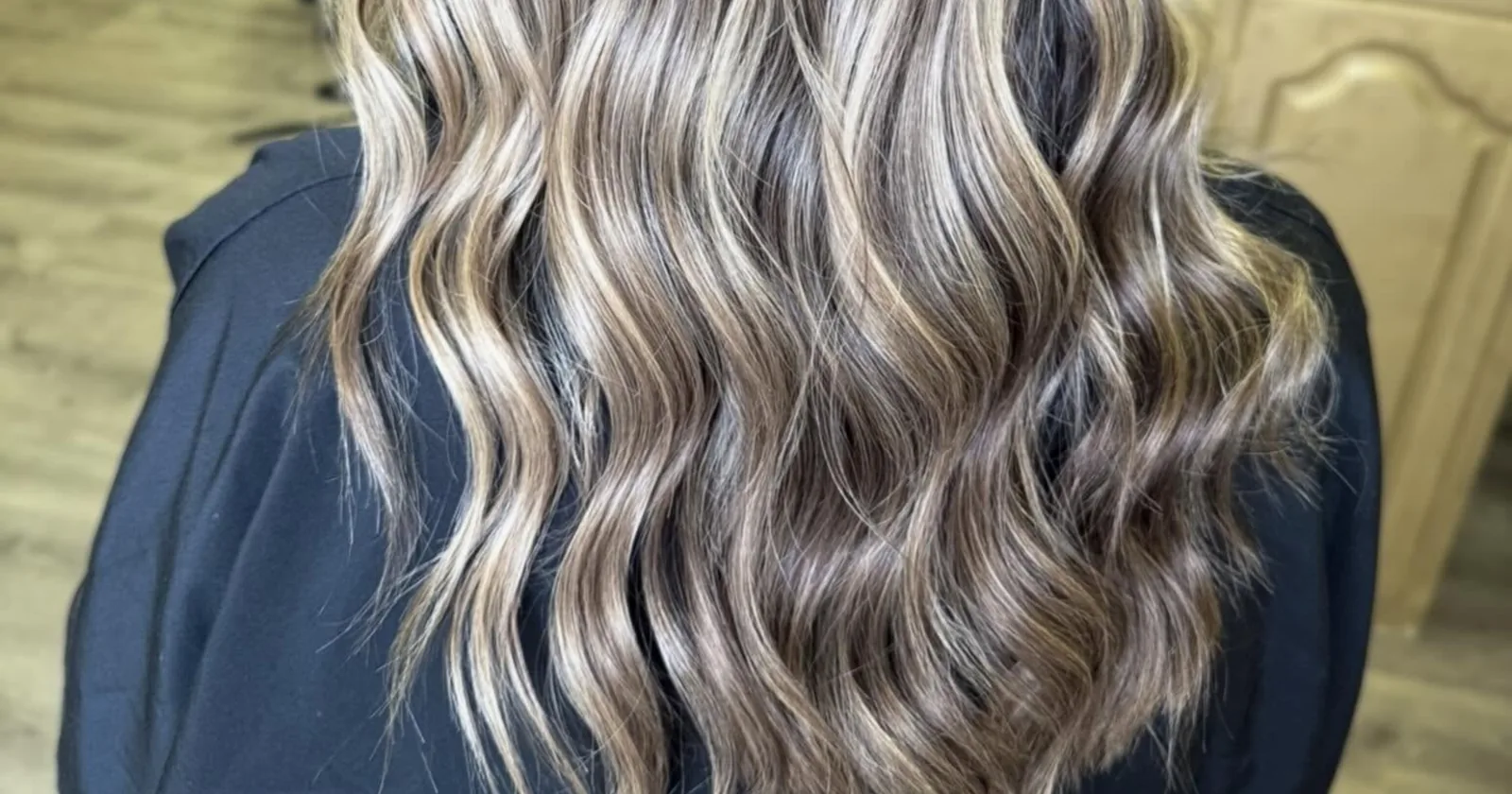
When a client sits down and says she wants to wear less makeup, we usually end up talking about her hair, not her face. A colour that suits her natural depth means less contouring to compensate. A cut that falls where her face is strongest does more than any highlighter.
Here's a concrete example I see constantly. Someone comes in with a cool ash blonde that's fighting warm skin, and she's been correcting for it with bronzer every morning. We warm the colour half a level — a gentle global tone, nothing dramatic — and the bronzer stops being necessary. She hasn't changed her makeup at all; the thing it was compensating for is gone.
Brows work the same way. A properly shaped brow is doing structural work for your whole face, which is why people who keep their brows tidy tend to wear less of everything else. It's not that they need less makeup — it's that the frame is already right.
Which is what "minimal makeup" really means: get the bigger things right, and you need fewer small things.
Common questions
Do I need a separate sunscreen if my foundation has SPF? Almost certainly yes — because of the application-amount problem. You'd need to apply roughly a teaspoon of foundation to your face to get the labelled SPF, and nobody does that. Use a dedicated sunscreen underneath.
Is SPF 50 meaningfully better than SPF 30? SPF 30 blocks 97% of UVB. Higher numbers block slightly more, but the AAD is clear that no sunscreen blocks everything. How much you apply and how often you reapply matters more than the label.
Do I still need sunscreen on an overcast Louisiana day? Yes. Up to 80% of UV penetrates cloud cover, so a grey August morning in Hammond is still doing the same work to your skin as a clear one.
Will powder keep my makeup in place in this humidity? Less than you'd hope. Powder absorbs moisture out of humid air, which is what makes it go patchy by mid-morning. Set your T-zone if you like, but leave cream products on the cheeks — they move with the skin instead of cracking on top of it.
Does minimal makeup mean I have to give up looking polished? No. It usually means moving the effort earlier — a cut and colour that suit you, and brows that are already shaped. When the frame is right, three products read as finished.
Ready to simplify what you're working with? I'm in the studio Tuesday through Saturday at 109 W Minnesota Park Rd, Suite 5 in Hammond. Book an appointment and let's talk about what your hair and skin actually need.
Cami Gerald is a licensed cosmetologist and the owner of Cosmetology by Cami in Hammond, Louisiana.